The Chapel Bridge Lucerne's Emblem and the 1993 Fire That Nearly Ended It
Two-thirds of the Chapel Bridge burned in 1993. Here is what survived, which paintings are original, and where to find Lucerne's other medievel bridge without the crowd.
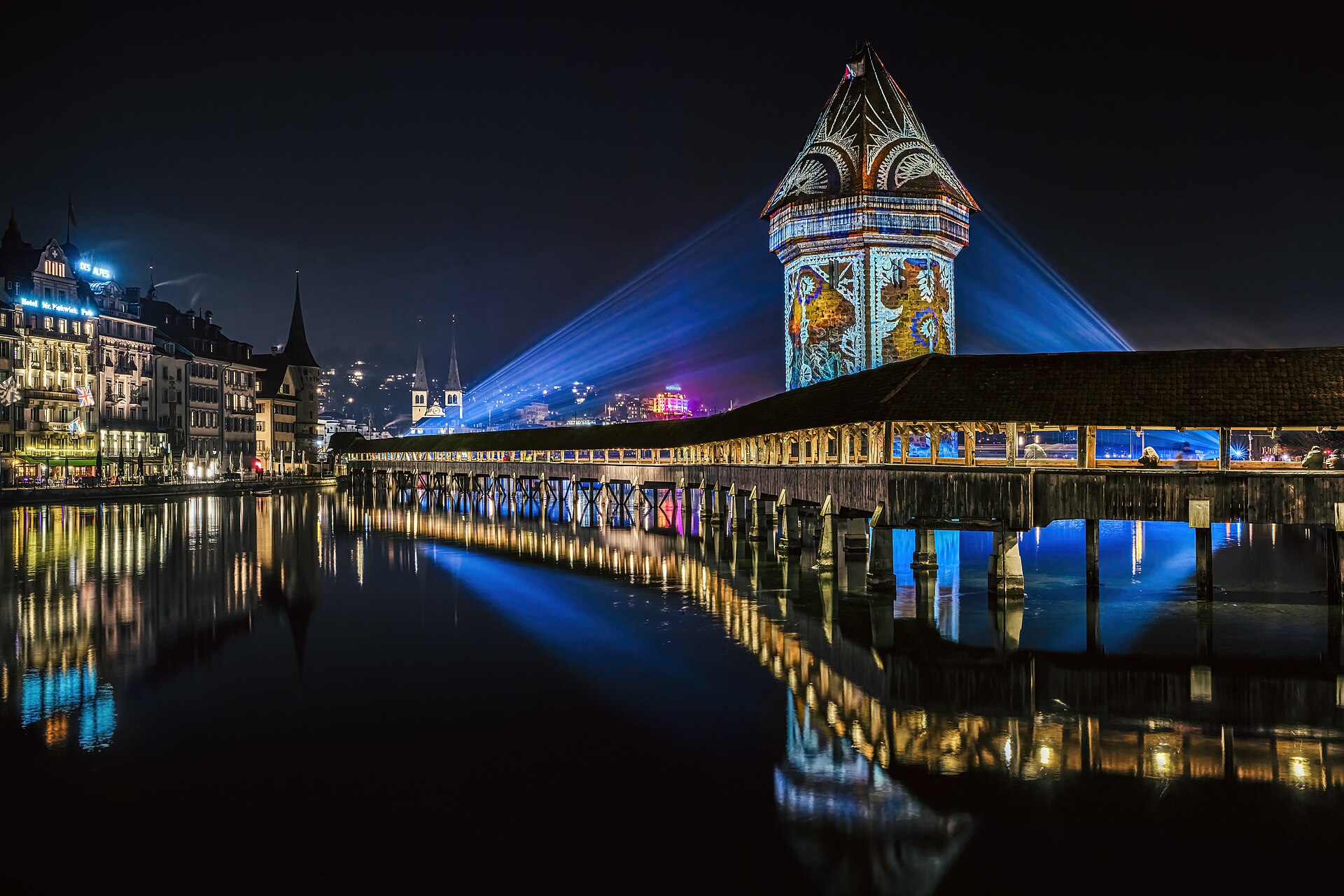

Most visitors photograph the Chapel Bridge without knowing two thirds of it burned to the waterline in August 1993. The triangular panels under the eaves you see today are mostly meticulous restorations. The fire that nearly ended the bridge destroyed 78 of the 158 period panels and blackened the entire eastern span. Yet the bridge you walk across now is the same 14th century structure, rebuilt and re-roofed within eight months. The story of the Chapel Bridge Lucerne fire is the story of how a medieval landmark came within hours of being lost forever, and how to tell which parts survived the flames.
- Construction Date: c. 1333 (bridge); c. 1300 (Water Tower)
- Length: 204.7 m after reconstruction (202.9 m originally)
- Fire Date: 18 August 1993
- Cause: Suspected cigarette or match igniting a moored boat
- Panels Destroyed: 78 of 158 original triangular panels lost
- Panels Saved: 30 undamaged; 47 salvaged and restored; 77 copies from 1993-94
- Panels Now on Display: 154 total (30 original undamaged, 47 restored damaged, 77 copies)
- Reconstruction Completed: 14 April 1994
- Water Tower Height: 34.5 m
- Water Tower Original Uses: Prison, torture chamber, treasury, municipal archive
- Water Tower Current Use: Guild hall for Lucerne Artillery Association; closed to public
- Spreuerbrücke Construction: 1408 (all 67 original panels from 1626-1635)
- Spreuerbrücke Theme: Dance of Death (Totentanz) by Kaspar Meglinger
- Peak Crowding Hours: 10:00-17:00 daily, July, August worst
- Quietest Hours: 06:00-08:00 and 21:00-23:00
The Chapel Bridge Lucerne Fire
How The Fire Started
The fire started just after midnight on 18 August 1993. A cigarette or match dropped into a boat moored beneath the eastern section of the bridge ignited the wooden hull. Flames climbed into dry, seven centuries old timber. Within hours, the fire had consumed the eastern third of the structure and two thirds of its panels. The western section, including the octagonal Water Tower, survived because firefighters cut the burning section loose and let it collapse into the Reuss River.
Reconstruction began immediately. The city of Lucerne reopened the repaired bridge on 14 April 1994, just eight months after the fire. Today 154 panels line the eaves. Of those, 30 are the undamaged period panels from the 1611 to 1632 cycle by Hans Heinrich Wägmann and his team. Another 47 panels were salvaged from the fire, damaged but restorable, left smoke stained and with less vivid colours. The remaining 77 are copies painted in 1993 and 1994.
Spot The Difference Yourself
The panels with darker, smoke damaged wood and muted paint are the restored survivors. The bright sharp panels are the copies. You can spot the difference yourself by looking up as you walk from the Lucerne train station side toward the Old Town.
Chapel Bridge History
A Fortified Crossing
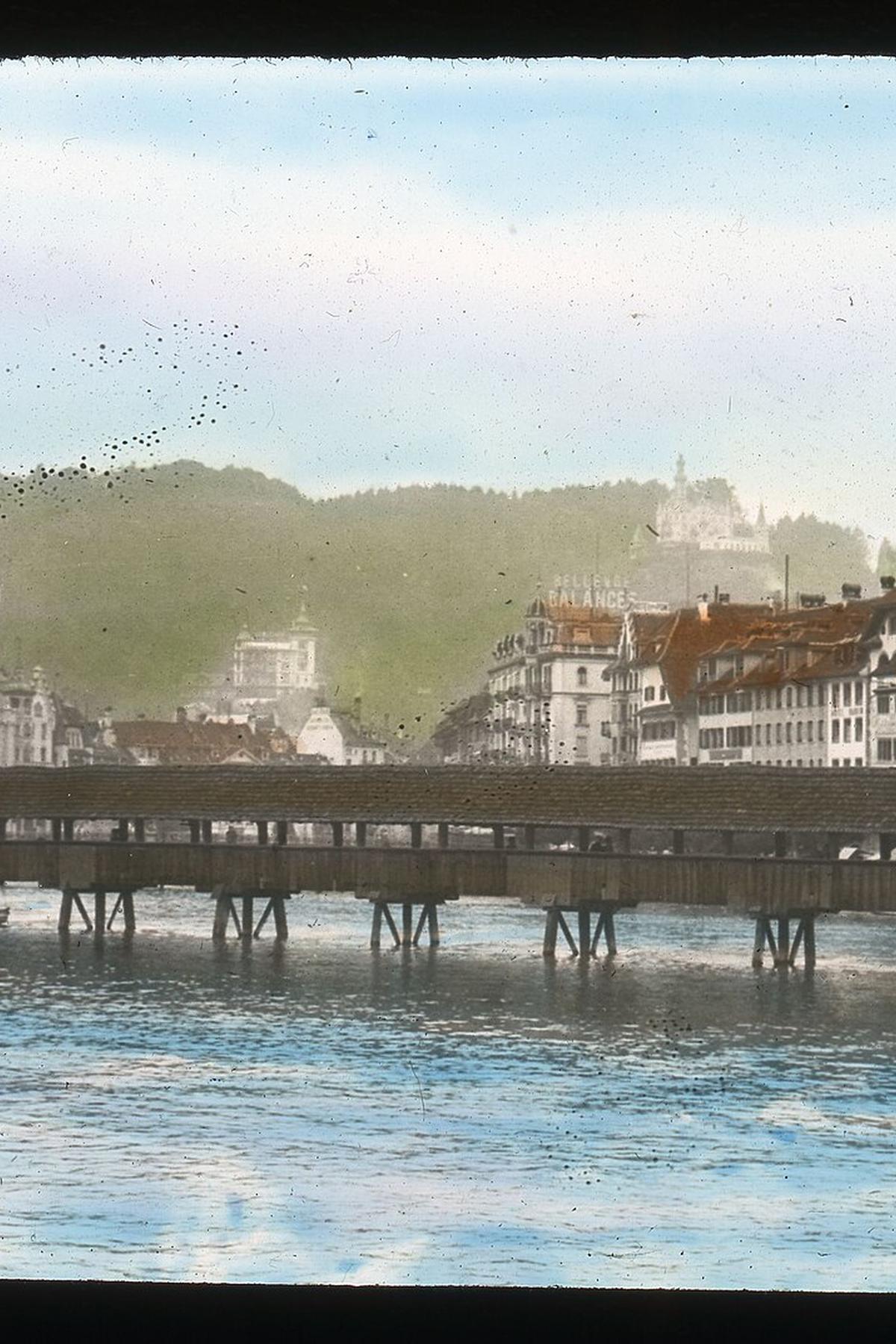
The bridge was built around 1333 as part of Lucerne's city fortifications. At 202.9 metres initially, it was the longest covered wooden bridge in Europe. After reconstruction it measures 204.7 metres. The bridge connected the Old Town on the right bank of the Reuss River to the newer settlement on the left bank, giving residents a protected crossing that also served as a defensive choke point.
The Water Tower
The octagonal Water Tower, or Wasserturm, was built around 1300, predating the bridge itself by roughly three decades. That tower never held water. Its name comes from its location on the river. It served as a prison, a torture chamber, a treasury, and the municipal archive over the centuries. Today it functions as a guild hall for the Lucerne Artillery Association and is closed to the public. You can photograph it from the bridge deck or from the riverbank promenade, but you cannot enter.
The Triangular Paintings
The triangular panels under the bridge eaves date from 1611 to 1632. Hans Heinrich Wägmann designed the cycle, and multiple painters executed the 158 panels. The paintings illustrate scenes from Swiss history and the lives of Lucerne's patron saints. They formed a narrative sequence that educated the largely illiterate population of the 17th century. The fire scattered that sequence: panels on the eastern approach were destroyed, while panels near the Water Tower survived largely intact.
Lucerne Chapel Bridge Paintings
The panels are the reason the bridge is more than a footbridge. Each triangular piece measures roughly 1.5 metres across the base and fits between the roof ridge and the side rail. The cycle told a continuous story of Lucerne's founding, its battles, and its religious identity. The 1611 to 1632 cycle by Wägmann replaced an earlier set that had deteriorated.
After the 1993 fire, the city faced a choice: replace the destroyed panels with blank timber, or commission new versions based on historical photographs and surviving fragments. They chose the latter. The 77 copies were painted by local artists working from archival images and the few undamaged period panels. The restored survivors, the 47 that came through the fire in damaged but salvageable condition, were cleaned and stabilised. The 30 undamaged ones needed no work.
Skip The Crowds, See The Real Thing
To see the genuine medieval article without the reconstruction, skip the main bridge and walk 400 metres downstream to the Spreuerbrücke. This 81 metre covered bridge was built in 1408 and carries all 67 of its period panels from 1626 to 1635. The theme is the Totentanz, or Dance of Death, painted by Kaspar Meglinger. Each panel shows Death claiming people from every station of life: the pope, the emperor, the merchant, the child, the soldier. The roof is the 15th century gabled timber, noticeably sagging in the middle. The panels have never been replaced or restored in the way the Chapel Bridge panels were. The Spreuerbrücke gets a fraction of the crowd, and it gives you the authentic medieval experience the Chapel Bridge cannot fully offer after 1993.
Is Chapel Bridge Worth Visiting
What You Are Really Here For
Yes, but not for the panels. Cross the bridge for the experience of walking the Reuss River on a seven century old wooden span with the Water Tower at its midpoint. Go for the flower baskets on the railings in summer, and for the view from the bridge deck toward the Old Town's painted facades and the Musegg Wall on the hill above. The bridge is a free walking route that connects the Lucerne train station and the boat pier on one side with the Old Town on the other. You will cross it naturally if you follow any standard walking route through central Lucerne. Do not go out of your way to avoid it.
The mistake most visitors make is stopping at the Chapel Bridge, taking the photograph, and moving on. Instead, budget 20 minutes. Cross slowly. Look up at the panels and identify which are the smoke darkened survivors and which are the bright copies. Then walk downstream to the Spreuerbrücke for the Dance of Death panels, the real medieval article. The two bridges, 400 metres apart on the same river, give you the complete story of Lucerne's covered bridge tradition.
When To Go
The bridge suffers peak crowding between 10:00 and 17:00, with July and August the worst months. Arrive between 06:00 and 08:00, or after 21:00. The bridge is open 24 hours, but sections are unlit after dark. Bring a torch if you cross late. For photography without the crowds, shoot from the riverbank during the evening illumination.

Lucerne Old Town Sights
A Two Hour Walking Loop
The Chapel Bridge is the centrepiece of the Lucerne Old Town, but it is not the only sight worth your time. The Old Town sits on the right bank of the Reuss River and is compact enough to cover on foot in two hours. The painted facades on the Weinmarkt and the Kornmarkt are the most photographed street scenes after the bridge itself. The Lion Monument, carved into a sandstone cliff in 1821 to commemorate Swiss Guards killed during the French Revolution, is a five minute walk from the bridge. The Musegg Wall, a surviving section of the 14th century city fortifications with nine towers, runs along the hill above the Old Town and offers a walking route with views over the lake and the Alps.
Beat The Tour Groups
The Lucerne train station and the main boat pier sit directly across the river from the Old Town, connected by the bridge. This means the bridge functions as the front door to the Old Town for anyone arriving by rail or boat. Arrive by 08:30 and cross toward the Old Town before the tour groups arrive. Walk through the Weinmarkt. Climb the Musegg Wall steps for the view. Return via the Spreuerbrücke on the downstream side. That loop covers the essential Lucerne Old Town sights in under three hours and uses both covered bridges.
Common Questions
How much of the Chapel Bridge is original after the 1993 fire?
The bridge structure is original apart from the eastern third that burned and was rebuilt. The roof and timber frame on the surviving western two thirds are the 14th century originals. Of the 154 triangular panels now in place, 30 are original undamaged panels from 1611-1632, 47 are restored originals salvaged from the fire, and 77 are 1993-94 copies. The Water Tower is entirely original, built around 1300, and survived the fire undamaged.
Can you go inside the Water Tower on the Chapel Bridge?
No. The Wasserturm is closed to the public. It serves as a guild hall for the Lucerne Artillery Association. You can photograph it from the bridge deck or the riverbank, but there is no public access.
Is the Chapel Bridge free to walk across?
Yes. The Kapellbrücke is a public pedestrian bridge open 24 hours at no cost. You do not need a ticket or a reservation. The same applies to the Spreuerbrücke 400 metres downstream.
How do you tell the original painted panels from the copies?
Look for darker, smoke stained wood and less vivid paint. Those are the restored originals. Panels with bright, sharp colours and clean wood grain are the 1993-94 copies. The original undamaged panels fall between these two appearance types but are the ones that show no smoke damage at all.
Which bridge has the better medieval paintings, Chapel Bridge or Spreuer Bridge?
Spreuer Bridge. All 67 of its Dance of Death panels are originals from 1626-1635 by Kaspar Meglinger, never replaced or restored in the way the Chapel Bridge panels were. The roof is the original 15th century gabled timber. The Kapellbrücke is the more famous landmark, but the Spreuerbrücke is the better art experience and gets far fewer visitors.
Read next
-
 Switzerland eSIM for Hong Kong Travellers and Which Network Actually Works in the Alps
Hong Kong travellers need a Switzerland eSIM that holds signal above 2,000 metres. Swisscom is the only network with true alpine coverage—here is where to buy it and where it still fails.
Switzerland eSIM for Hong Kong Travellers and Which Network Actually Works in the Alps
Hong Kong travellers need a Switzerland eSIM that holds signal above 2,000 metres. Swisscom is the only network with true alpine coverage—here is where to buy it and where it still fails.
-
 Switzerland Hotels Hostels and Mountain Huts What Each Is Actually Like
Swiss accommodation spans CHF 50 hostel dorms to five-star Zermatt resorts—learn what a mountain hut stay actually involves, what half-board means and where families get the best value.
Switzerland Hotels Hostels and Mountain Huts What Each Is Actually Like
Swiss accommodation spans CHF 50 hostel dorms to five-star Zermatt resorts—learn what a mountain hut stay actually involves, what half-board means and where families get the best value.
-
 Switzerland Where to Stay Choosing Your Base for Mountains and Cities
Choose two or three Swiss bases maximum to avoid wasting half-days on mountain transfers—compare Wengen, Lucerne, Zermatt, Grindelwald and Interlaken for families, hikers and first-time visitors.
Switzerland Where to Stay Choosing Your Base for Mountains and Cities
Choose two or three Swiss bases maximum to avoid wasting half-days on mountain transfers—compare Wengen, Lucerne, Zermatt, Grindelwald and Interlaken for families, hikers and first-time visitors.
-
 Switzerland Flights from Hong Kong Direct and Connecting Options Compared
Direct Cathay Pacific and Swiss flights from Hong Kong to Zurich take 12 hours 40 minutes, while Geneva requires a connection—compare fares, seasons and what each route costs in HKD.
Switzerland Flights from Hong Kong Direct and Connecting Options Compared
Direct Cathay Pacific and Swiss flights from Hong Kong to Zurich take 12 hours 40 minutes, while Geneva requires a connection—compare fares, seasons and what each route costs in HKD.
-
 Top Destinations in Switzerland: A Tour of the Must-See Places
Switzerland may be small, but every corner has its own character, from cosmopolitan lakeside cities to car-free mountain villages and Italian-flavoured southern towns. This tour runs through the destinations most Hong Kong travellers put at the top of their list, with a sense of what each offers and
Top Destinations in Switzerland: A Tour of the Must-See Places
Switzerland may be small, but every corner has its own character, from cosmopolitan lakeside cities to car-free mountain villages and Italian-flavoured southern towns. This tour runs through the destinations most Hong Kong travellers put at the top of their list, with a sense of what each offers and
-
 Switzerland in Winter vs Summer: Which Season Should You Choose?
Switzerland is one of those rare destinations that reinvents itself completely with the turning of the seasons. Visit in January and you find a hushed, snow-blanketed wonderland of ski slopes and steaming mountain restaurants. Return in July and the same valleys are green and buzzing, laced with wil
Switzerland in Winter vs Summer: Which Season Should You Choose?
Switzerland is one of those rare destinations that reinvents itself completely with the turning of the seasons. Visit in January and you find a hushed, snow-blanketed wonderland of ski slopes and steaming mountain restaurants. Return in July and the same valleys are green and buzzing, laced with wil
-
 The Complete Guide to Switzerland for Hong Kong Travellers
Switzerland packs an astonishing amount into a small country: snow-crowned Alps, glassy lakes, medieval old towns and some of the most scenic railways on earth. For Hong Kong travellers used to dense cities and humid summers, it offers a refreshing change of pace, clean mountain air and a rail netwo
The Complete Guide to Switzerland for Hong Kong Travellers
Switzerland packs an astonishing amount into a small country: snow-crowned Alps, glassy lakes, medieval old towns and some of the most scenic railways on earth. For Hong Kong travellers used to dense cities and humid summers, it offers a refreshing change of pace, clean mountain air and a rail netwo
-
 Riding the Glacier Express and Switzerland's Great Scenic Trains
There are countries where the train is simply a way to get from one place to another. Switzerland is not one of them. Here, the railway is the destination in its own right, a slow-moving grandstand seat for some of the most spectacular scenery in Europe. For Hong Kong travellers used to fast, effici
Riding the Glacier Express and Switzerland's Great Scenic Trains
There are countries where the train is simply a way to get from one place to another. Switzerland is not one of them. Here, the railway is the destination in its own right, a slow-moving grandstand seat for some of the most spectacular scenery in Europe. For Hong Kong travellers used to fast, effici
-
 The Swiss Lakes Guide: Cruises, Lakeside Towns and Where to Dive In
Switzerland is a country of mountains, but it is also, gloriously, a country of water. Scattered across the map are lakes of every size and character, from vast, glamorous expanses fringed by vineyards to quiet mountain waters the colour of jade. They are the soul of many of the country's most belov
The Swiss Lakes Guide: Cruises, Lakeside Towns and Where to Dive In
Switzerland is a country of mountains, but it is also, gloriously, a country of water. Scattered across the map are lakes of every size and character, from vast, glamorous expanses fringed by vineyards to quiet mountain waters the colour of jade. They are the soul of many of the country's most belov